
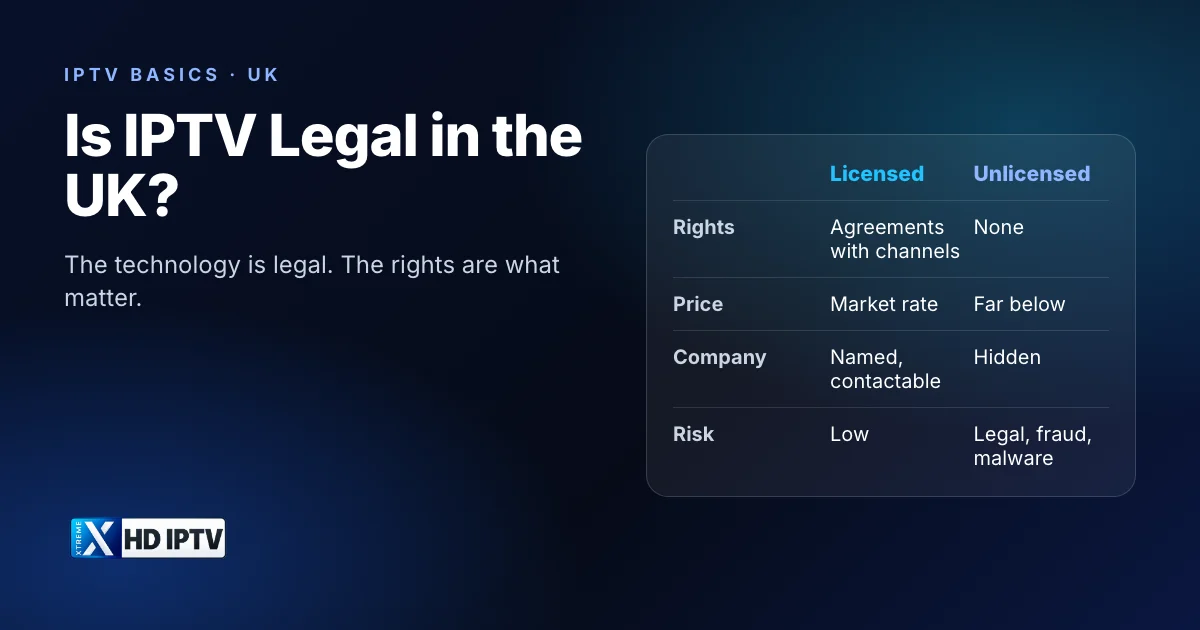
“Is IPTV legal?” is one of the most common questions about internet TV in the UK, and it is often answered badly, either with a blanket “yes” from sellers or a blanket “no” from scare stories. The honest answer depends on the service, not the technology. This guide explains how the law treats IPTV in the UK, what the court cases show, the risks for viewers and how to check a service before you pay. It is general information, not legal advice; if you need advice about a specific situation, speak to a solicitor.
The short answer
- IPTV technology is legal. It is just TV delivered over an internet connection.
- A service is only legal if it has the rights to distribute the channels and content it streams.
- Supplying unlicensed streams is a crime in the UK, and has led to long prison sentences.
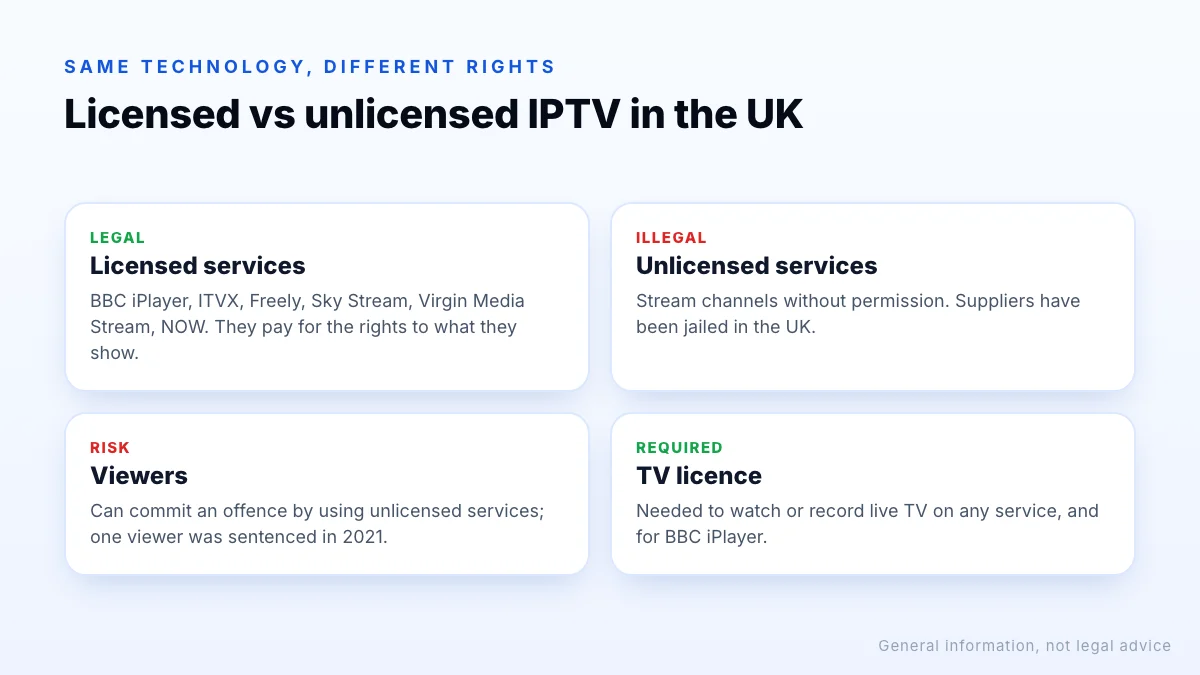
- Watching unlicensed streams can also be an offence, and at least one viewer has been sentenced, though enforcement mostly targets sellers.
- A TV licence is required to watch live TV on any service.
Legal IPTV in the UK
A large share of UK TV viewing is already IPTV. Legal services that deliver TV over the internet include:
| Service | What it is |
|---|---|
| BBC iPlayer, ITVX, Channel 4, 5 | Broadcasters streaming their own channels live and on demand |
| Freely | Free live TV over broadband on compatible smart TVs, backed by the main broadcasters |
| Sky Stream / Sky Glass | Sky TV delivered over broadband instead of satellite |
| Virgin Media Stream, EE TV and others | TV packages from broadband providers |
| NOW | Sky channels and sport on a monthly pass, through its own app |
All of these hold agreements with the channels they carry. If IPTV is new to you, see what IPTV is and our overview of IPTV in the UK.
What makes a service unlicensed
TV channels, films and sports events are protected by copyright. Broadcasters and sports leagues sell the right to show them, often for very large sums. A service that takes those channels and streams them to its own paying customers without permission is infringing copyright, whatever technology it uses. In UK cases, operators of such services have been convicted of copyright and fraud offences.
The risks for viewers
Criminal risk
Enforcement in the UK has focused on the people who run and sell unlicensed services, often through private prosecutions brought by the Premier League with the anti-piracy body FACT. In July 2021, a man who ran a pirate IPTV service was sentenced at Liverpool Crown Court to 16 months for supplying it and a separate four months for using it himself. In 2023, five men behind a large pirate IPTV operation were jailed for a combined total of more than 30 years. FACT has said that end users are committing offences when they access illegal streaming services.
Practical risks
- Losing your money. Unlicensed services disappear without notice, often with no refund.
- Payment and identity data. You are handing card or account details to people operating outside the law.
- Malware. Unofficial apps and “loaded” devices can carry malicious software.
- No recourse. If the service stops or misbehaves, there is no legitimate company to complain to or claim against.
Warning signs of an unlicensed service
- Every premium sports and movie channel for a fraction of what licensed services charge.
- Saturday 3pm Premier League matches shown live: they are not broadcast live in the UK by licensed services.
- No company name, address or registered business details.
- “Lifetime” subscriptions or payment only through untraceable methods.
- Sold mainly through social media messages or preloaded “fully loaded” devices.
Not legal advice
What about VPNs?
VPNs are legal in the UK and widely used for privacy. But a VPN doesn't change whether a service is licensed: watching an unlicensed stream through a VPN is the same activity, just harder to trace. Equally, using a VPN with a legitimate service to appear to be in another country may breach that service's terms. A VPN is a privacy tool, not a licence.
If you've already paid for a service you're unsure about
- Stop using it and remove any unofficial apps it asked you to install.
- Cancel any recurring payment and check your bank or card statements.
- If you paid by card, ask your card provider about a chargeback if the service was misrepresented.
- Change any password you reused when signing up.
- If you think you were scammed, report it to Action Fraud.
The TV licence still applies
Separately from copyright, UK law requires a TV Licence to watch or record live TV on any channel or service, on any device, and to watch BBC programmes on iPlayer. That applies to legal IPTV too. You don't need one for on-demand-only services such as Netflix or Disney Plus.
The licence is a separate legal requirement from copyright: having a TV licence doesn't make an unlicensed service legal, and a licensed service doesn't remove the need for a TV licence when you watch live TV.
How to check a service
- Find out who runs it. A legitimate service names its company and how to contact it.
- Ask how its channels are licensed. A licensed service can tell you.
- Compare the price with licensed services for the same channels. If it is a small fraction, ask why.
- Check where it is sold. Official websites and app stores, not unsolicited messages.
- Read the terms on refunds, renewals and what happens if the service stops.
- Search the name with “scam” or “shut down” to see whether there are recent warnings.
These questions apply to any provider you consider, including us. Our general provider checklist covers reliability and support too, and our free IPTV guide lists legal free options.
The bottom line
IPTV is legal technology used by the BBC, Sky and every major UK broadcaster. Whether a particular service is legal depends on whether it has the rights to what it streams. Supplying unlicensed streams has led to prison sentences in the UK, viewers have been prosecuted in at least one case, and the practical risks of fraud, lost payments and malware are real. Check who runs a service and how its channels are licensed before paying, keep a TV licence for live TV, and take legal advice if you need certainty about a specific situation.