
Adding “Reddit” to a search is a common way to cut through polished review sites and hear from real people. For IPTV, “Reddit best IPTV” is a popular query for exactly that reason. Forum threads can be genuinely useful, but they also have blind spots, and IPTV discussions attract more than their share of fake recommendations and scams. This guide explains what threads can tell you, what they can't, and how to turn them into a test you run yourself.
Why people search Reddit for IPTV
Review sites often rank services in an order shaped by affiliate commissions, and many look the same. Forums feel different: posters describe their own setups, complain when things break and answer each other's questions. That makes them good for questions like “is anyone else having problems tonight?” or “which player works best on my TV?” Our guide to the best IPTV service covers the limits of review sites in more detail.
Threads also capture things review sites rarely mention: how a service behaved during a big final, whether a price rise was announced fairly, or how long a refund took. Those details are hard to fake at scale and are often the most useful part of a discussion, as long as you check that several people independently describe the same experience.
What Reddit threads are good for
- Setup help: getting a player working on a particular device, and fixing common errors.
- App comparisons: what people like and dislike about TiviMate, IPTV Smarters Pro, Kodi and others.
- Outage reports: whether a problem is widespread or just you.
- Support experiences: how providers respond when something goes wrong.
- Red flags: patterns of services disappearing, changing domains or failing to refund.
- Network quirks: reports that a particular broadband provider or router setting causes problems, with workarounds.
For device and app questions in particular, community threads can be faster than official help pages. Our player app guide covers the same ground with links to official sources.
The blind spots
| Blind spot | Why it matters | What to do |
|---|---|---|
| Threads date quickly | Services change, close or move domains | Sort by new and check post dates |
| Other people's setups | Their devices and connections aren't yours | Test on your own equipment |
| Survivor bias | Happy users stay quiet; unhappy ones post | Weigh patterns, not single posts |
| Planted posts | Some accounts exist to promote one service | Check account history |
| Location differences | Performance can vary by country and network | Look for posters in your region |
There is also a timing problem. A thread asking for the best service in January may be the top search result in October, by which time the recommended services may have changed hands, raised prices or closed. When services shut down, look-alike sites often appear using their names, and old threads can send people straight to them.
Scams that target IPTV threads
Because people asking for recommendations are ready to buy, IPTV threads attract scammers. Common patterns:
- Unsolicited direct messages offering a service, a discount or a “private” list after you post a question.
- Payment by gift card or untraceable methods only. The US Federal Trade Commission warns that anyone insisting on gift-card payment is very likely a scammer.
- Lifetime deals and “reseller” offers with no company details.
- Look-alike websites using the name of a well-known service that has closed or moved.
Some communities limit naming services
How to read a thread critically
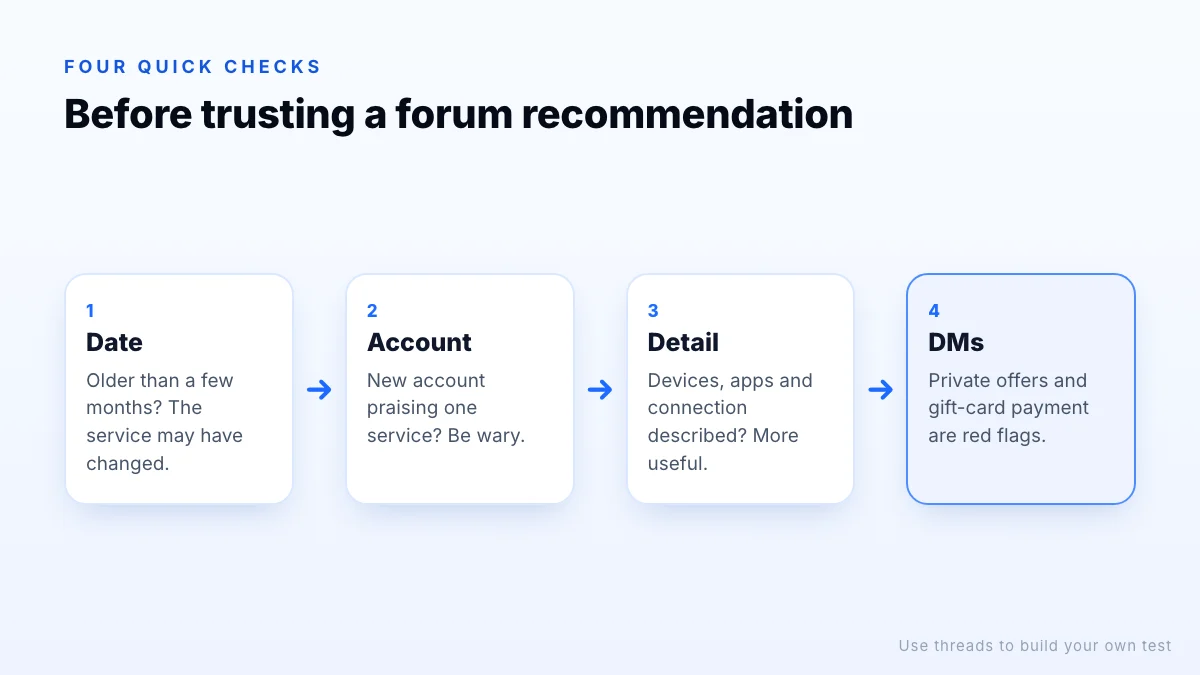
- Check the date. Anything older than a few months may describe a service that has changed.
- Check the account. A long history of varied posts carries more weight than a new account praising one service.
- Look for detail. Devices, apps, connection type and how long they have used the service.
- Look for patterns. Several independent posters reporting the same problem is meaningful; one angry post is not.
- Separate facts from opinions. “Support replied in an hour” is useful; “best service ever” is not.
- Read the replies. Other users often correct outdated or misleading claims in the comments.
If a thread leaves you with two or three candidates, that is a good result. Narrowing further is a job for your own trial, not for more reading.
Asking a good question
If you post yourself, you will get far better answers by giving people what they need to help. Include your device (for example “Fire TV Stick 4K Max” or “LG TV, 2021”), the player app you use or plan to use, how you connect (Wi-Fi or Ethernet), roughly how fast your connection is, and what you mainly watch. Ask about specific behaviour, such as “does anyone see buffering on 4K sport in the evening with this app?”, rather than “what's the best IPTV?”, which mostly attracts spam and private messages.
Other places worth checking
- Official app pages and help centres for player apps such as Kodi, VLC and TiviMate, which are more reliable than threads for setup steps.
- Your device maker's support pages for settings, updates and known issues.
- Consumer protection guidance, such as the FTC's advice on avoiding scams, before paying anyone you found online.
- The provider's own website: who operates it, how to contact them, and what the terms say about refunds and plan lengths.
Review platforms with star ratings can help too, but read the written reviews rather than the score, and look at how the company replies to complaints.
From thread to test
The most valuable thing a thread gives you is a list of things to check yourself:
- problems people report at peak times, so you test in the evening;
- apps that work well on your device, so you use one of them for the trial;
- support complaints, so you send a question and time the reply;
- billing complaints, so you read the terms before paying;
- device-specific bugs, so you test on the exact device you own.
Then run a short trial using our provider checklist. If something goes wrong, our troubleshooting guide helps you tell whether the problem is the service or your setup.
The bottom line
Reddit and other forums are good for setup help, app advice and spotting widespread problems, but weak at picking a specific service: threads date quickly, describe other people's setups and attract planted posts and DM scams. Use them to build your test list, not to make the decision. Then test any service, including ours, on your own devices in the evening with a trial before paying for a long plan.