“Best IPTV service”, “top rated IPTV”, “best IPTV 2026”: these are some of the most searched phrases in the whole topic, and the results are full of confident rankings that rarely agree. We sell an IPTV service ourselves, so we won't pretend to rank competitors neutrally. Instead, this guide explains what “best” actually depends on, gives you a scorecard to judge any service, including ours, and shows how to read rankings without being misled.
Why there's no single “best”
The same service can be excellent for one household and frustrating for another, because results depend on:
- Your devices. A service that works smoothly on a new Android TV box may feel slow on an older smart TV.
- Your connection. Distance from the router, Wi-Fi quality and evening congestion all change what you see.
- What you watch. One person's essential channel is irrelevant to another.
- When you watch. Peak-time stability matters most for live sport.
- Where you are. Route and server distance can affect performance in different countries.
That is why a ranking written by someone else, on their devices and connection, can only ever be a rough guide.
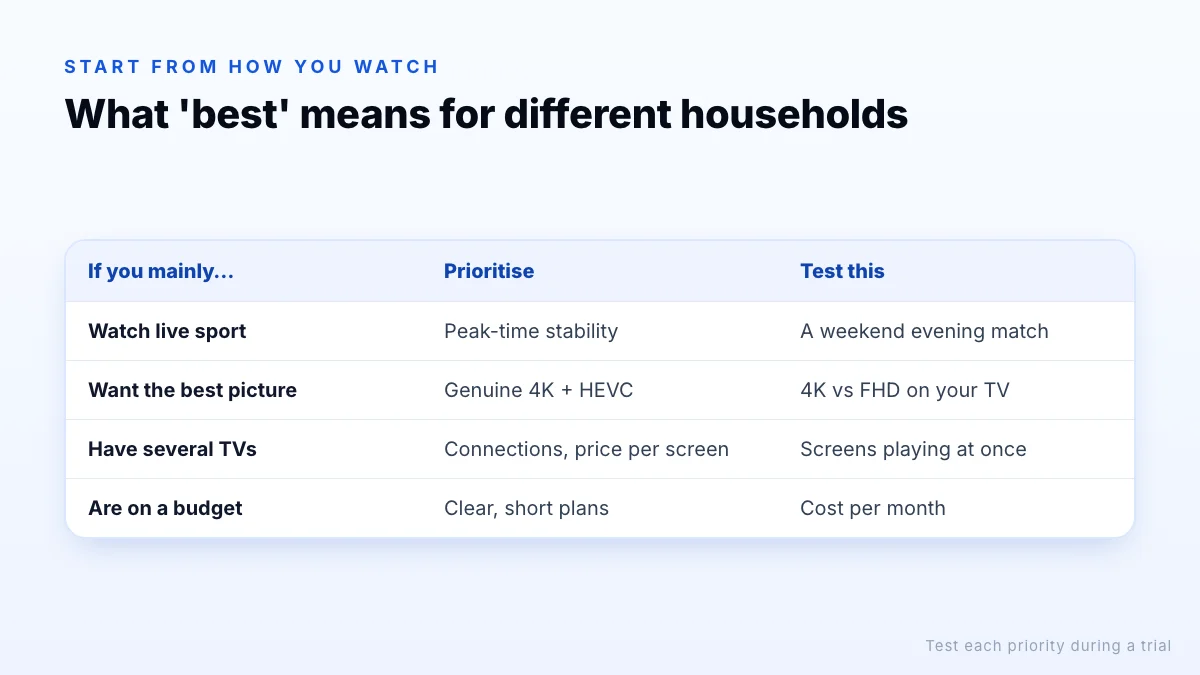
What “best” means for different households
| If you mainly… | Prioritise | Test this |
|---|---|---|
| Watch live sport | Stability at peak times, FHD/HD fallbacks | A big match on a weekend evening |
| Want the best picture | Genuine 4K channels, HEVC support on your device | 4K versions vs FHD on your TV |
| Have several TVs | Enough connections, good price per screen | Two or three screens playing at once |
| Are on a tight budget | Clear pricing, short plans to start | Cost per month for your screens |
| Are not technical | Simple setup, responsive support | How quickly support answers a question |
| Use one specific app | Supported login type for that app | Signing in on your actual device |
A simple scorecard
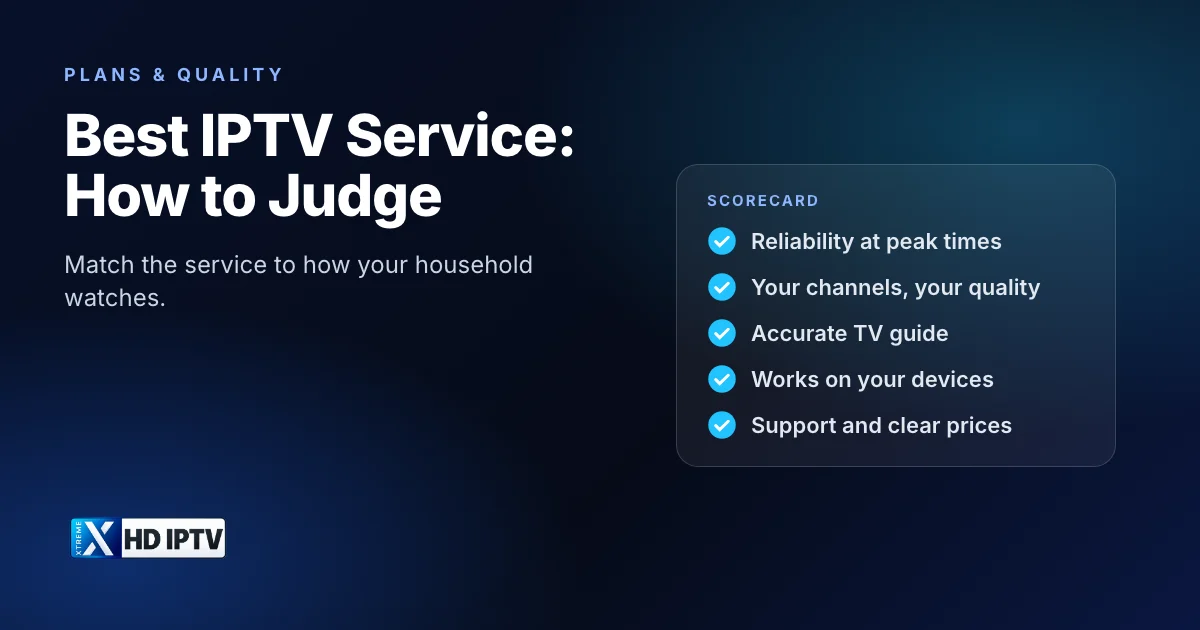
Score each shortlisted service from 1 to 5 on these points during a trial:
- Reliability: did your main channels play without interruption in the evening?
- Channels: are the ten channels you watch most present, in the quality you want?
- Guide: is the TV guide accurate for those channels?
- Devices and apps: did setup work on every device you use?
- Support: how quickly and helpfully did they answer a question?
- Price clarity: do you know exactly what you'll pay, for how many screens, for how long?
Weight the scores by what matters to you: a sports fan might double reliability, a family might double devices. The highest weighted score is your best service. Our provider checklist explains each point in more detail.
How to read “best IPTV” and “top rated” lists
- Look for a commission disclosure. Many review sites earn money for each sign-up, which can shape the order.
- Check the date and the testing method. Services change quickly, and “tested” can mean anything from weeks of use to a quick look at a website.
- Be wary of identical lists. The same services in the same order across many sites often means the same affiliate programme.
- Distrust guarantees. “Never buffers” or “100% uptime” can't be true for every viewer, because your own connection is part of the chain.
Community discussions are more candid but have their own limits; our guide to Reddit “best IPTV” threads covers how to use them.
Recommended by whom?
A “recommended IPTV service” from a friend with the same broadband provider and the same streaming stick is worth more than one from a stranger online, because their setup is closer to yours. Even then, ask what they watch and when: a recommendation from someone who watches films on demand tells you little about live sport on a Saturday evening. Treat every recommendation as a candidate for your shortlist, then let your own trial decide.
Is the biggest provider the best?
Not necessarily. A large provider may have more infrastructure, but it also has more viewers competing for it at peak times. A headline channel count, ours included at 20,000, mostly reflects variety and duplicate quality versions, not whether your channels are reliable. Size is worth less than how the service performs on your own screen.
Comparing prices like for like
Prices only compare fairly when the terms match. Work out the cost per month for the number of screens you need, on the same plan length, and note what each price includes: on-demand content, catch-up, recording and the number of connections. A plan that looks cheap for one screen can cost more than a rival's two-screen plan once you add a second TV. Our own prices are listed on the pricing page, with plans for 1 to 5 connections and 1 to 12 months, so you can compare them in the same way.
Red flags when a service claims to be “best”
- Lifetime plans for a one-off payment.
- Guarantees of zero buffering on any connection.
- No company details or way to contact anyone before paying.
- Payment only by gift card or other untraceable methods.
- Pressure to pay immediately to keep a discount.
- Reviews that only praise, with no mention of a single problem or limitation.
“Best IPTV 2026” and other year lists
Year labels signal freshness, but a page titled “best IPTV 2025” or “2026” may simply have had its title updated. Look for concrete details that show recent testing, such as dates, devices and specific observations, rather than generic praise. And remember that services can change, close or move domain between one year and the next.
A fair test beats a recommendation
A one-week test plan
- Day 1: install on your main device, sign in, find your ten key channels.
- Days 2–3: watch in the evening; note any buffering and when.
- Day 4: try a second device and two screens at once, if you need that.
- Day 5: compare 4K, FHD and HD versions of a sports channel.
- Day 6: send support a question and time the reply.
- Day 7: fill in the scorecard and decide.
If you hit problems, check whether they are on your side with our IPTV troubleshooting guide before blaming the service.
The bottom line
The best IPTV service is the one that holds up on your devices, at your busiest times, with your channels, at a price you understand. Rankings, year lists and “biggest provider” claims are starting points at most. Decide what matters to your household, score a shortlist during real evening viewing, and only then commit to a longer plan. We're happy to be tested the same way: request a trial and run the scorecard on us.