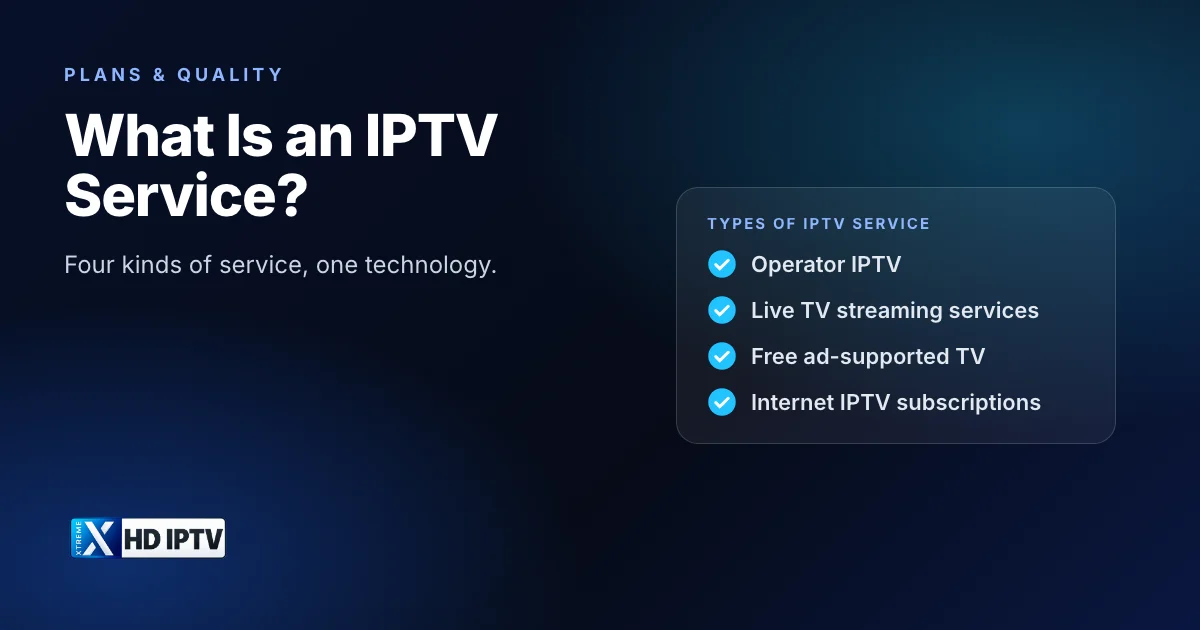
“IPTV service” sounds like one specific product, but it describes a whole category: the TV package from your broadband provider, a live TV app on your phone, the free channels built into your smart TV and the subscriptions sold for use in third-party player apps can all be IPTV services. This guide explains what they have in common, how the four main types differ, what you get and what they cost, so you can tell which kind suits your household before comparing individual providers.
What counts as an IPTV service
An IPTV service delivers live TV channels, and usually on-demand video, over an internet protocol (IP) network, instead of through a broadcast aerial, a satellite dish or a traditional cable TV signal. It normally includes a programme guide, so you can see what is on and switch channels as you would with cable. For the technology behind it, see what IPTV is and how IPTV uses internet protocol.
Purely on-demand services such as Netflix also stream over IP, but because they have no live channels they are usually called streaming services rather than IPTV. In everyday use, people searching for an “IPTV service” usually mean a subscription to live channels that works through an app on their own devices, which is the fourth type described below.
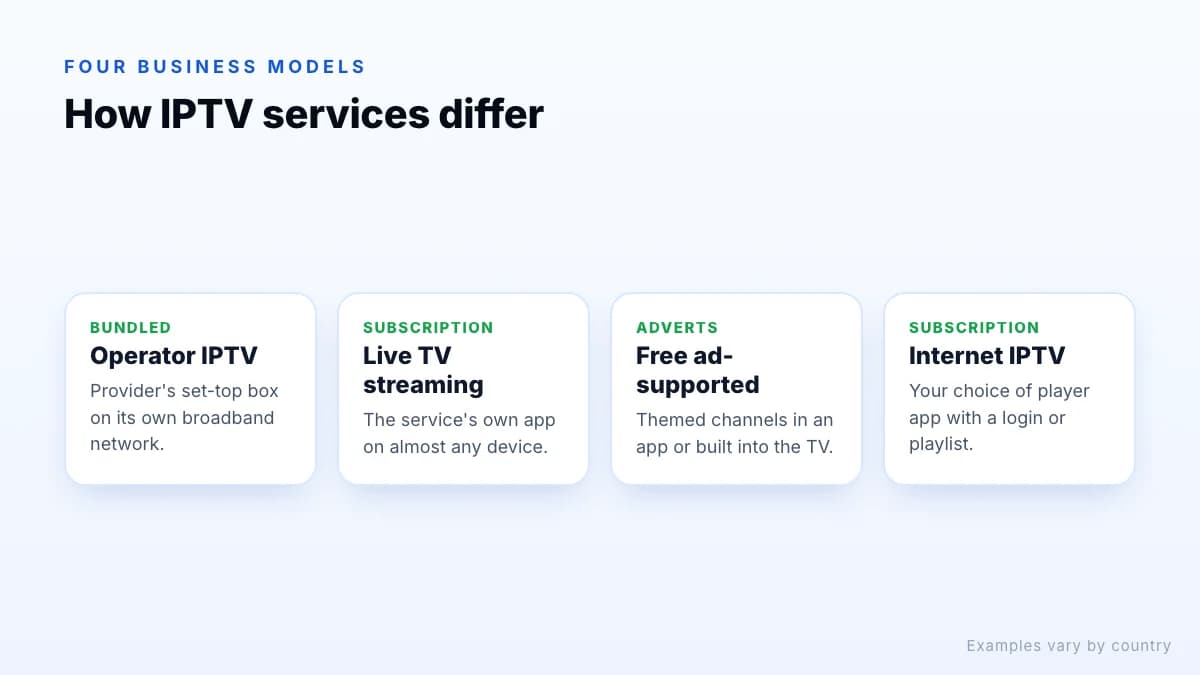
The four types of IPTV service
| Type | How you watch | Typical examples | Paid for by |
|---|---|---|---|
| Operator IPTV | Provider's set-top box on its broadband network | TV packages from broadband and telecom companies | Subscription, often bundled with broadband |
| Live TV streaming service | The service's own app on TVs, sticks and phones | YouTube TV, Sling TV, Fubo, Hulu + Live TV (US) | Monthly subscription |
| Free ad-supported TV | App or built into the TV | Pluto TV, Tubi, Samsung TV Plus; Freely (UK) | Advertising |
| Internet IPTV subscription | Third-party player apps on your own devices | Independent IPTV providers | Monthly or yearly subscription |
Operator IPTV
Many broadband companies sell TV delivered over their own network to their own set-top box. Because the operator controls the network, it can prioritise TV traffic and use multicast, so picture quality is consistent. The trade-off is that you are tied to that provider's box and broadband.
Live TV streaming services
Services such as YouTube TV and Sling TV in the US sell live channel packages watched through their own apps on almost any device. They work over any broadband connection and usually include cloud recording.
Free ad-supported TV
FAST services stream themed channels for free, funded by adverts. Our free IPTV guide lists the main ones in the US and UK.
Internet IPTV subscriptions
Independent providers sell access to channel lists and on-demand libraries that you load into a player app such as IPTV Smarters Pro or TiviMate, using an Xtream Codes login or an M3U playlist. They are flexible about devices, but quality and legitimacy vary widely between providers.
How an IPTV service works
- The service receives channel feeds and encodes them for streaming in one or more qualities.
- Streams are delivered over IP, either within an operator's network or across the internet.
- An app or set-top box shows the channel list and guide, and requests the stream you choose.
- Your account controls what you can watch and how many screens can play at once.
What you get with a service
- Live channels, grouped by category, sometimes in several qualities.
- A TV guide (EPG) showing what is on now and next.
- On-demand content: films and series to start any time.
- Catch-up or cloud recording on some services and channels.
- A number of simultaneous streams, often called connections or screens.
- Support when something goes wrong, ideally through a channel you already use, such as chat or email.
How many screens you need is the most common question when choosing a plan; see how many connections you need.
What IPTV services cost
Prices vary by type and country, and change often, so check providers directly. In broad terms, free ad-supported services cost nothing, operator IPTV is usually priced as an add-on to broadband, and live TV streaming services and internet IPTV subscriptions charge monthly, with discounts for longer terms on some services. For reference, our own plans start at $15 for one month on one connection; the pricing page lists every option.
When comparing, convert each option to a monthly cost for the number of screens you need, and add any equipment or broadband you would have to buy.
Licensing: why it matters
TV channels are licensed content. Operators, live TV streaming services and FAST services pay for the right to distribute the channels they carry. Services that offer thousands of premium channels, including major sport, at a price far below what licensed services charge are often not licensed to distribute them. That matters for reliability, because unlicensed streams are taken down, and in some countries for viewers too; see our guide to whether IPTV is legal in the UK.
Questions worth asking any service
Questions to ask before you subscribe
- Which devices and apps does the service support, and which login types?
- How many screens can play at the same time on each plan?
- Is there a trial or a short plan to test with?
- Does it include a TV guide, catch-up or recording?
- How do you contact support, and when are they available?
- What happens when the plan ends: does it renew automatically?
- Who operates the service, and where is that stated on its website?
Choosing a type of service
- Want the simplest, most consistent setup? Operator IPTV from your broadband provider.
- Want to watch on any device with recording? A live TV streaming service.
- Want free background TV? A FAST service or your broadcasters' apps.
- Want to choose your own player and devices? An internet IPTV subscription, chosen carefully.
Whichever type you lean towards, our provider checklist covers what to test before paying, and our guide to the best IPTV service for your household matches services to how you watch.
The bottom line
An IPTV service delivers live TV, usually with on-demand content and a guide, over an IP network. The four main types, operator IPTV, live TV streaming services, free ad-supported TV and internet IPTV subscriptions, share the technology but differ in how you watch, what you pay and how their channels are licensed. Decide which type fits your household first, then compare providers within it, and test before committing with a trial where one is offered.