
Canadians searching for “IPTV Canada” are usually trying to cut the cost of TV, follow hockey without a cable box, or understand the cheap IPTV subscriptions they see advertised. Canada is a useful case because IPTV is already mainstream there, and because Canadian courts have taken a clear position on unlicensed services. This guide covers the main options, sport, internet requirements and what to check before paying for any service.
What IPTV means in Canada
IPTV is TV delivered over an internet protocol network rather than through traditional cable TV signals, satellite or an antenna. In Canada, several of the largest TV providers already deliver their service this way over their own fibre and broadband networks, and streaming services deliver Canadian channels over the open internet. For the technology behind it, see how IPTV uses internet protocol.
The main options in Canada
| Type | Examples | Notes |
|---|---|---|
| Provider TV over internet networks | Bell, Rogers, Telus, Vidéotron | Usually bundled with their internet service |
| Streaming services | Crave, Sportsnet+, TSN+ | Monthly subscriptions through their own apps |
| Free streaming | CBC Gem and free ad-supported services | Free, with adverts on some |
| Over-the-air antenna | Local broadcast stations | Free; not IPTV, but a useful complement |
| Independent IPTV subscriptions | Services used through player apps | Check licensing carefully |
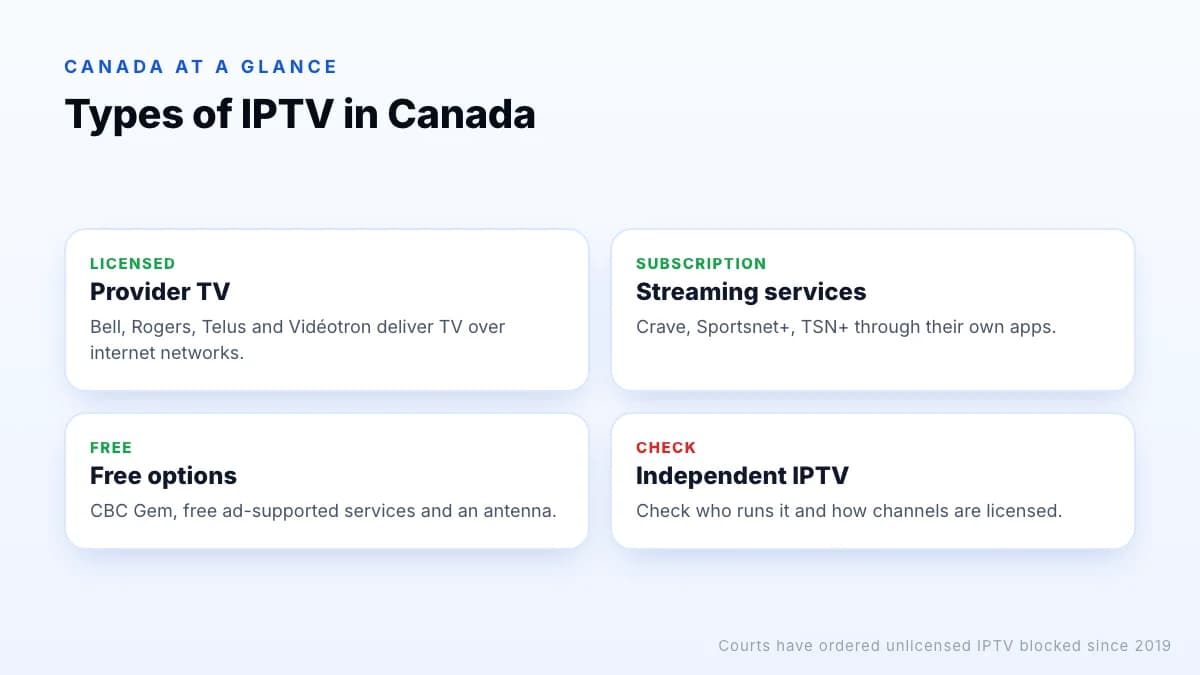
Provider packages are licensed and regulated, and come with their own boxes or apps. Streaming services let you pay for specific content, such as sport or premium series, without a full TV package. Combining an antenna, a free service and one or two streaming subscriptions is a common way to cut costs.
French-language TV
French-language viewers, especially in Quebec, have their own set of services. Vidéotron is the largest provider in Quebec, and Radio-Canada's ICI TOU.TV streams French-language programming, with a free tier and a paid extra tier. When comparing services, check that French-language channels and sport commentary are included if your household needs them; English-focused packages and many independent services treat them as an afterthought.
Canadian content
Canada's broadcasting regulator, the CRTC, sets rules for licensed TV providers, including requirements around Canadian content and basic service packages. That is one reason Canadian provider packages are structured differently from US ones, and why some US channels and streaming services are not offered in Canada.
Hockey and other sports
Sport is the main reason many Canadians keep paying for TV. Rights are split between national and regional broadcasters, so the games of a particular NHL team may be on a national network one night and a regional channel the next, with streaming services such as Sportsnet+ and TSN+ carrying their own broadcasters' games. Before choosing, list your teams and leagues and check which services carry them where you live, including any regional blackout rules.
Cross-border confusion
Other sports
The same pattern applies beyond hockey. Basketball, baseball, football and soccer rights are split between Canadian broadcasters and their streaming services, and international events are licensed separately again. If you follow several sports, compare which combination of services covers all of them at the lowest total cost, rather than assuming a single package will.
Internet speed and devices
As a general guide, plan for about 5 Mbps per HD stream, 10 Mbps for Full HD and 25 Mbps or more for 4K, and add them up for every screen watching at once. Rural connections and busy evening periods are the usual weak points, so test on the TV device itself. See our internet speed guide.
Common devices in Canada include Fire TV, Google TV and Android TV devices, Apple TV, Roku and smart TVs. Check that your chosen service has an app for your device, and see how to watch IPTV on your TV for the options.
Site blocking and unlicensed services
In November 2019, in Bell Media Inc. v. GoldTV.biz, the Federal Court of Canada issued the country's first order requiring internet providers to block access to an unlicensed IPTV service. The Federal Court of Appeal upheld the order in May 2021, and courts have since granted further blocking orders against pirated streams, including live sport. For viewers, the practical consequence is that unlicensed services can stop working without warning, on top of the usual risks of lost payments, no support and malware in unofficial apps.
Warning signs of an unlicensed service:
- Every Canadian and US channel and every sports package for a few dollars a month.
- No company name, address or contact details.
- “Lifetime” deals or payment only through untraceable methods.
- Sold mainly through social media or preloaded “fully loaded” boxes.
These checks apply to any provider, including ours; our provider checklist covers what else to test.
Cutting costs legally
- Start free: an antenna for local stations and CBC Gem cover a lot of everyday viewing.
- Subscribe by season: streaming sports services can be paused or cancelled outside the season you follow.
- Avoid paying twice: check what your internet bundle already includes before adding a separate service.
- Share sensibly: check how many simultaneous streams a plan includes before paying for a second subscription in the same household.
- Review promotions: provider prices often rise when introductory offers end, so diarise the date.
Checklist for Canadian viewers
- List the channels and teams you watch, including French-language channels if needed.
- Check what is free: an antenna and CBC Gem may cover more than you expect.
- Compare provider packages and streaming services for what remains.
- Check the service is offered in Canada and runs on your devices.
- Count screens that will watch at the same time; see how many connections you need.
- Check who runs any independent service and how its channels are licensed.
- Test in the evening, ideally during a game, before committing to a long plan.
- Check whether prices are in Canadian or US dollars, and whether your card adds a foreign exchange fee.
Working through the list usually shows that a combination of free options and one or two licensed services covers most households for less than a full traditional TV package.
The bottom line
IPTV is mainstream in Canada: the major providers deliver TV over internet networks, and streaming services cover Canadian channels and sport. Start with what is free, add the services that carry your teams and shows, and check speed and devices. With independent services, remember that Canadian courts have ordered unlicensed IPTV services blocked since 2019, so check who runs a service and how its channels are licensed, and test with a trial or short plan before committing.